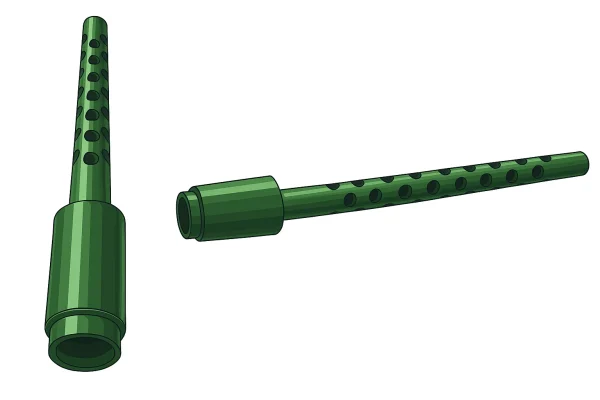
What is a Core Barrel?
A Core Barrel is a highly specialized cylindrical drilling tool designed to extract intact, cylindrical samples (cores) of rock, soil, or concrete during drilling operations. This component plays a critical role in defence and civil engineering applications where accurate geological or structural analysis is required. The core barrel works by cutting an annular ring around the intended core material, preserving the core’s natural integrity, which enables precise examination and planning for construction or excavation.
Key Components of Core Barrel
Outer Barrel
Rotates with the cutting bit, creating the annular cut into the material.
Inner Barrel
A non-rotating tube that retains and protects the extracted core sample during retrieval.
Head Assembly
Ensures alignment and smooth rotation, often featuring pressure-balanced bearings and optimized threads to withstand vibration and reduce misalignment.
Core Lifter and Stop Ring
Devices within the inner barrel mechanism that securely hold the core sample in place, preventing loss or damage while retrieving.
Cutting Bit
Typically a diamond or roller-cone bit attached to the bottom of the outer barrel for efficient material penetration.
Precise Core Extraction: Its primary function is to extract cylindrical core samples from underground formations without fracturing or contaminating them. The outer barrel cuts around the core, while the inner barrel safely contains the extracted sample.
Sample Protection and Retention: The inner barrel’s core lifters and stop rings securely grip the core sample during retrieval, preventing slippage, breakage, or loss as the barrel is withdrawn from the borehole.
Efficient Drilling Performance: Designed with durable cutting bits and smooth rotation mechanisms, the core barrel minimizes drilling vibrations and accelerates penetration rates, enhancing overall operational efficiency.
Adaptability to Various Formations: Core barrels can be equipped with different bit types and internal mechanisms suitable for diverse material types, including hard rock, soft rock, soil, and concrete, allowing versatile application across projects.
Data Accuracy: By maintaining core integrity, it provides geologists and engineers with accurate, undisturbed samples for analysis, essential for making informed decisions regarding resource exploitation, structural foundations, or environmental assessments.
Operational Safety: Its robust design reduces the risk of core jams or equipment failure, contributing to safer drilling environments and reducing downtime.