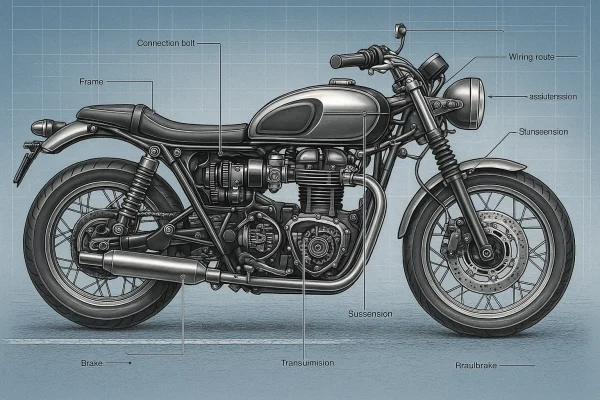
What is a Motor Cycle Assembly?
Motorcycle assembly comprises the integration of various parts and systems that together create a functional motorcycle. It includes the frame, engine, transmission, suspension, wheels, and control systems, each engineered for performance, safety, and rider comfort.
Key Features of Brake Head
Robust Frame
Made from steel or aluminum alloys, the frame forms the structural backbone, supporting the engine and rider while providing rigidity to withstand dynamic forces.
Powerful Engine
The engine can be single-cylinder, parallel-twin, V-twin, or multi-cylinder, designed to efficiently convert fuel to mechanical power for propulsion.
Advanced Suspension System
Front forks and rear shocks absorb road irregularities, ensuring smooth rides and handling stability.
Reliable Transmission
Gearboxes with 5-6 speeds help regulate engine power to the rear wheel through chain, shaft, or belt drives, enabling controlled acceleration.
Ergonomic Controls
Handlebars, foot pegs, and control levers provide intuitive and responsive rider input for steering, throttle, and braking.
Structural Support: The frame supports all components and the rider, maintaining overall motorcycle integrity.
Power Generation: The engine produces necessary torque and power to move the motorcycle.
Power Transmission: The transmission system delivers engine power effectively to the rear wheel.
Shock Absorption: Suspension systems reduce vibrations, protecting rider comfort and vehicle stability.
Steering Control: Handlebars and front forks allow precise directional control.
Braking System: Front and rear brakes enable controlled deceleration and stopping.
Energy Management: Electrical components manage ignition, lighting, and instrumentation for safe operation.